Racing in parametric worlds | Galactic Racers
A free browser racing game for playing with friends. Built in a couple of days using Fable, drawing on my earlier generative art experiments.
I made a game. Galactic Racers is a free browser space racer. Pick a spacecraft, choose a planet, and race with friends or bots through a procedurally generated world.
Here's what it looks like in motion.
Why this game?
I wanted to make something I could play with my friends. Keeping it free and in a browser was part of that: send a link, open a room, come race.
I kept coming back to the flying machines and planets in Oban Star-Racers and Star Wars. I wanted to make a game where I could fly through places like those.
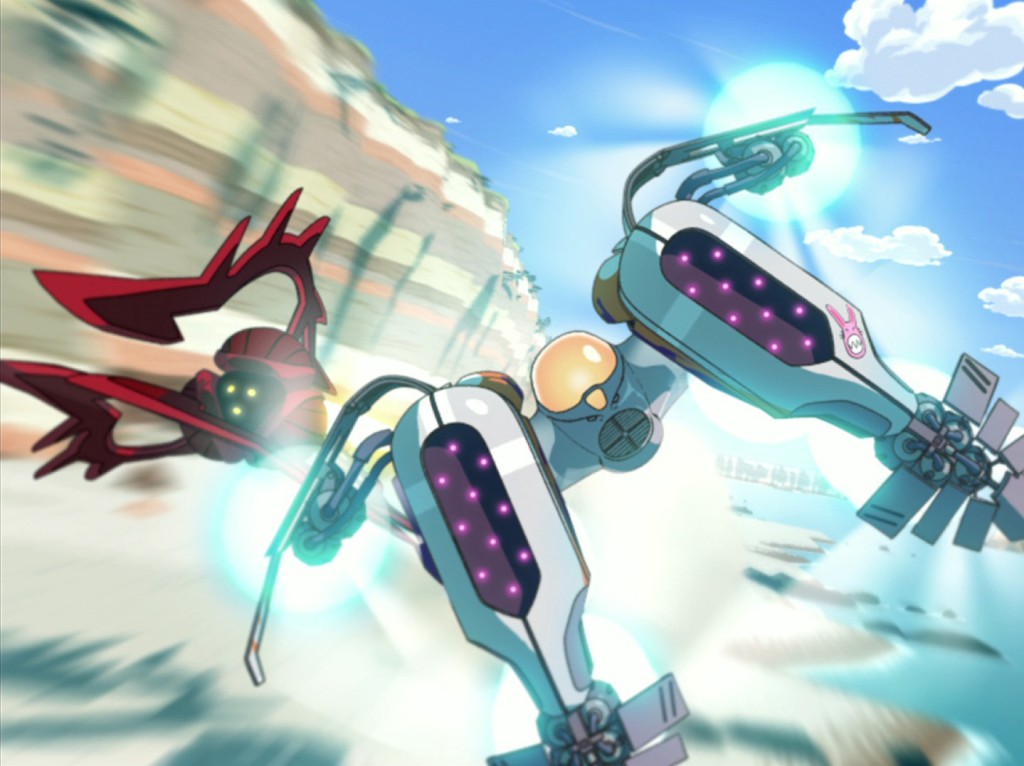 A race in Oban Star-Racers.
Image: official Oban Star-Racers Blu-ray campaign.
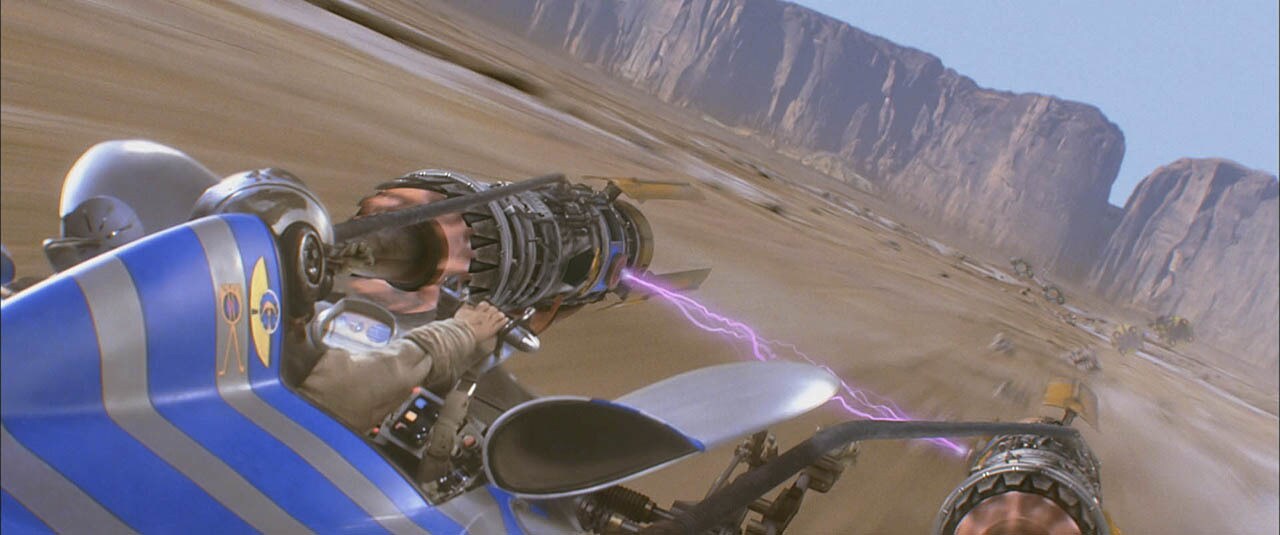 Podracing in Star Wars: The Phantom Menace.
Image: Lucasfilm, via StarWars.com.
I've been making these worlds for a while
Looking at the game, I can see a direct connection to two of my earlier generative art projects, Fermi Paradox and Terra. Both were made in cables.gl in 2022.
Fermi Paradox imagined UFOs as watchers of other worlds. In this iteration, a small geometric craft hangs above a mountainous patch of terrain. Changing the parameters gave me different versions of the craft and its surroundings.
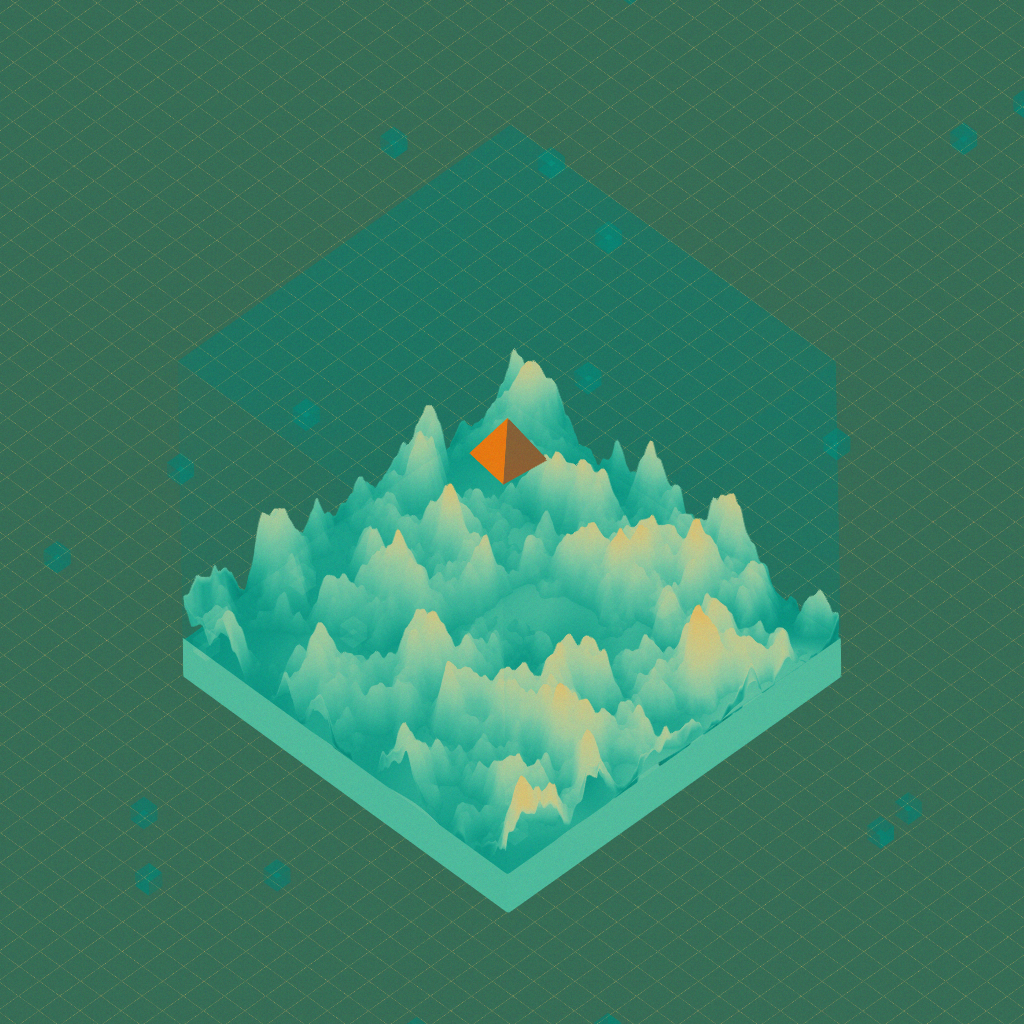 Fermi Paradox, 2022. One of my earlier experiments with spacecraft and generated landscapes.
Terra imagined drones searching for habitable planets as Earth was dying. Noise and basic geometry produced different landscapes and classes of drones. After Terraforming, I was thinking about planetarity and what makes a planet habitable. Terra let me explore that through imagined landscapes and the machines sent to survey them.
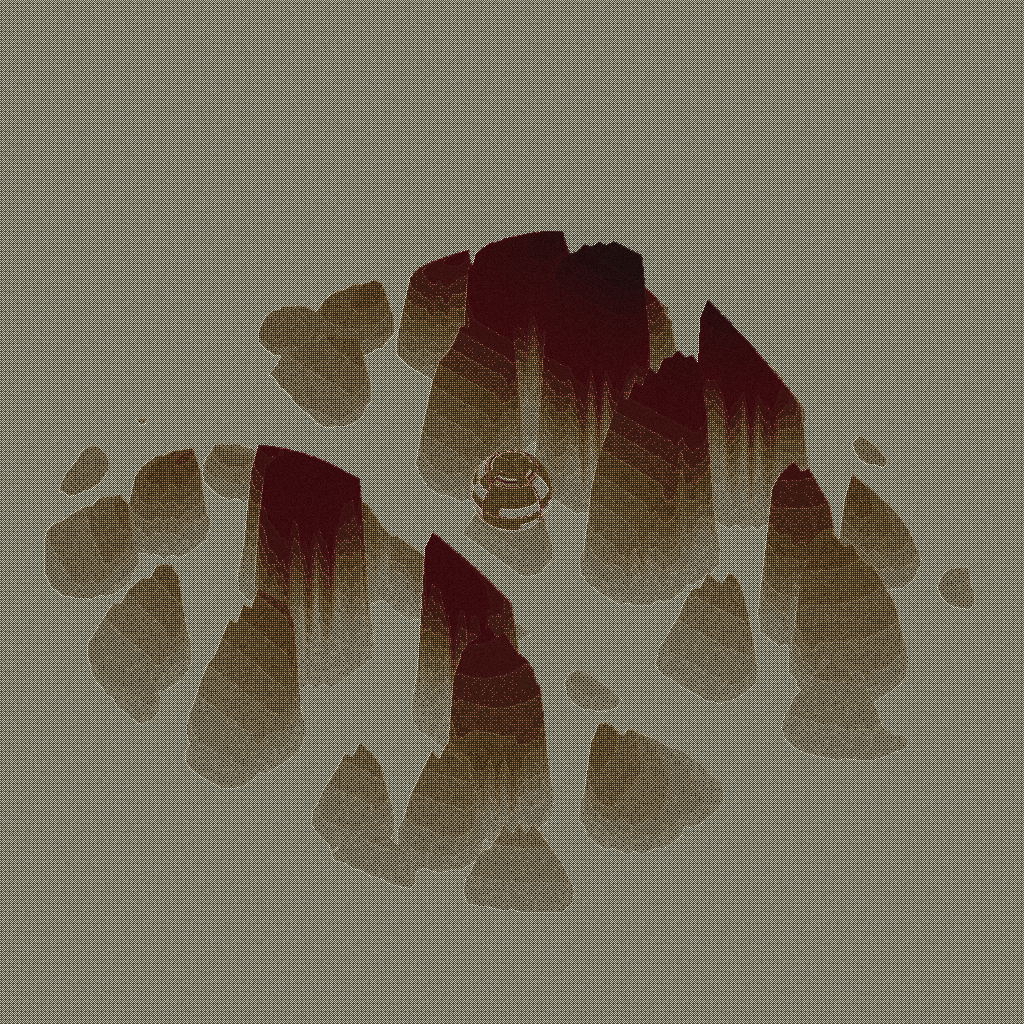 Terra, 2022. Drones surveying procedurally generated terrain.
Galactic Racers gave me a reason to revisit those experiments. This time, someone has to steer through the terrain. A rock formation can block your path, and a narrow valley makes a turn harder.
Building the rules
My practise is building tools. I enjoy defining a system and finding out what it can produce. Here, that means deciding how much a spacecraft or landscape can change while still making sense as something you can race with or through.
The craft are assembled from parts: hulls, wings, engines, fins. Parameters change their proportions and arrangement. Each planet defines a range of terrain, colours and environmental conditions, including things like drag and gravity that affect movement.
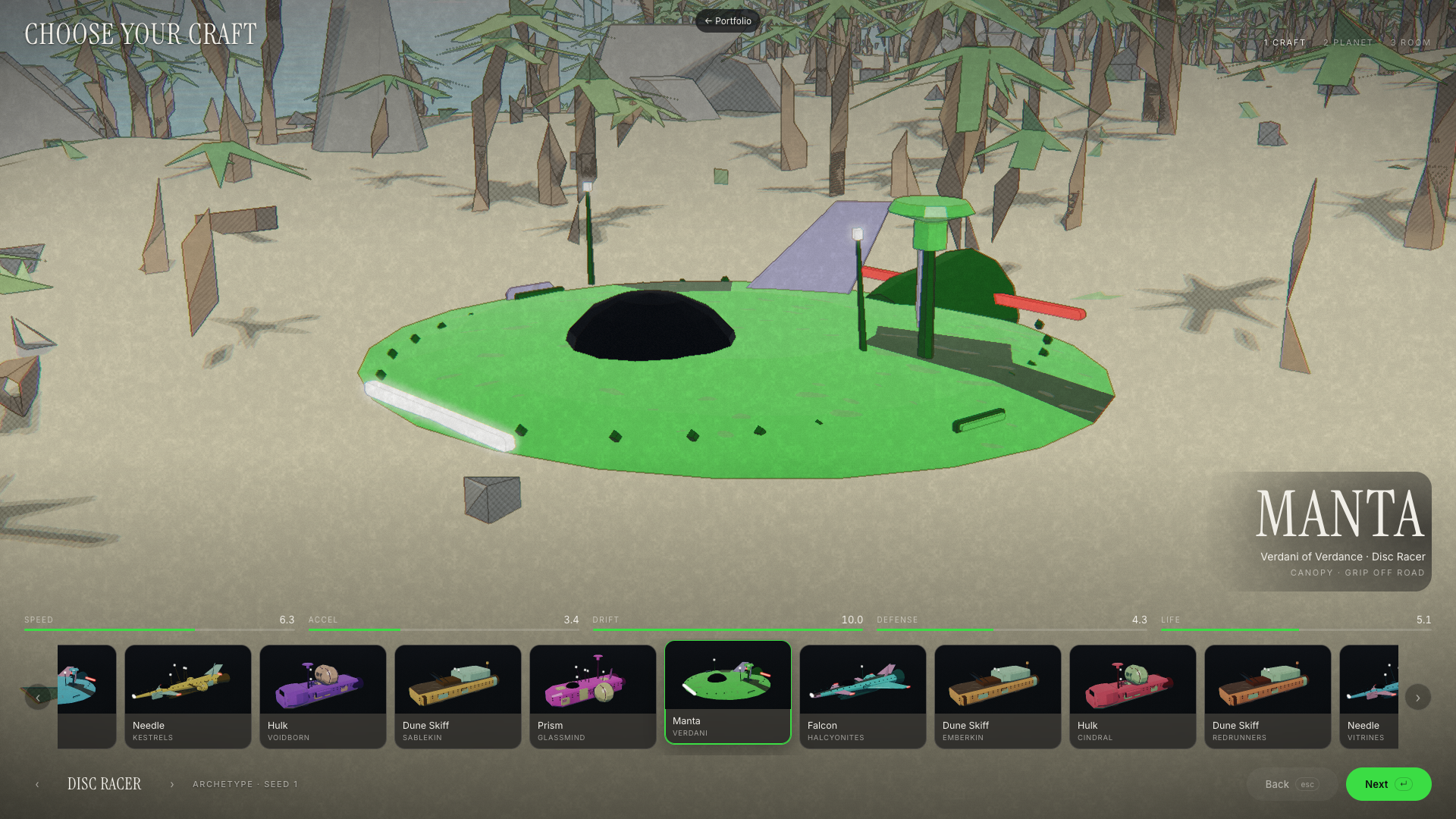 Parametric parts become spacecraft you can choose and fly.
A seed is the starting value for generating a world and its course. Change it and you get a new configuration. Keep it and you can return to the same track. In multiplayer, everyone uses that shared starting point, so you can learn a course together or try somewhere unfamiliar.
The part that surprised me
I built this out in a couple of days using Fable. That still feels a little insane to me.
With Fermi Paradox and Terra, I had manually built the geometry and connected the logic in cables.gl. I was used to spending time on each of those pieces myself.
I hadn't expected to get from those experiments to a playable multiplayer game so quickly. It makes me want to go back through my older work and see what else I could turn into a game.
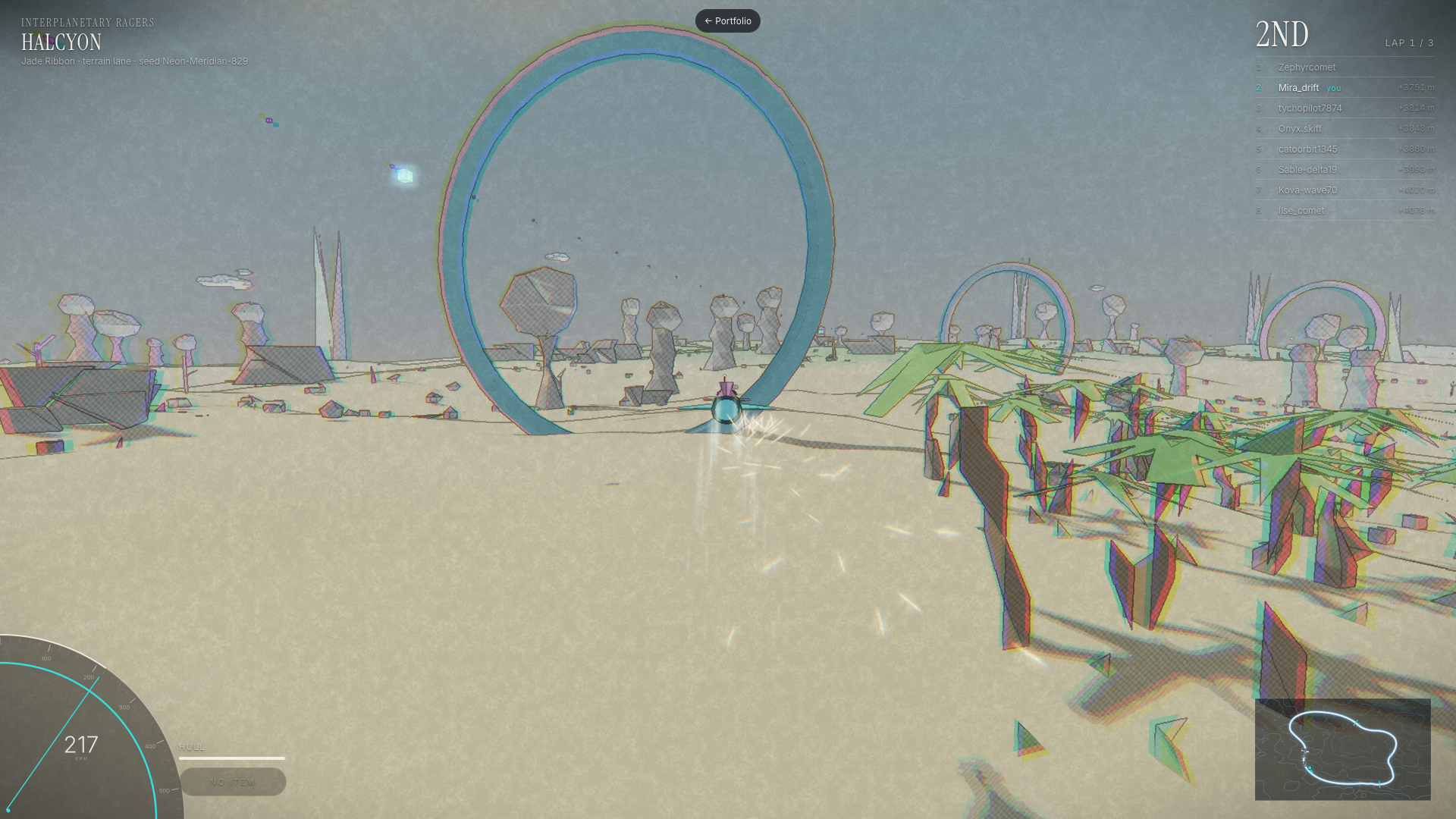 Racing through gates on Halcyon.
Having it running is only the start. I still need to judge how the steering feels, whether the camera helps, and whether you can see the next turn in time.
Give it a go. Bring a friend, or race the bots. I'd like to know whether you want another lap.
Best with a keyboard. Requires a browser and device with WebGPU support.
Read more
- Vibe coding a musical instrument Introducing the Instrument - speculative exploration of a slightly different digital musical instrument.
- The end | Generative Art '22A cosmic fidget spinner with 90s ambient audio simulating the feeling of being stuck in loops, with emergent behaviour.
- Tool-making as an art practiceTool-making is an art practice. Not the things you make with tools, the tools themselves are objects of power that shape how we think and who we become. I've spent eight years making tools as both generative art and AI products, and the line between them was never as clear as I thought. Every tool carries a philosophy. This is about what I've learned, and the questions I'm still sitting with.