The Politics of Taste
Taste is not a feeling, it's infrastructure for power, and in the AI era, the substrate itself is now property.
A few months ago I wrote
Taste is a feeling you've interrogated enough to understand, and therefore transfer.
I want to push on what the piece left unsaid.
The argument I made was about taste as a personal capacity. Skill in, edge out. Wide consumption, active dissection, a position you can articulate and bring to the next piece of work. Most of the response treated taste as a moat: the scarce thing left after AI commoditizes production, the difference between an interface that ships and one that resonates.
That part I think is mostly right.
But taste has never been only a capacity. It is one of the oldest political technologies we have. Its function, across five centuries, has been to convert positional advantage into apparent preference. To make what you happen to like look like who you happen to be, with the labor of acquisition rubbed off. If taste is becoming the new credential in an AI-saturated economy, it is worth being honest about what kind of credential it is.
A five hundred year old trick
The founding text is Baldassare Castiglione's The Book of the Courtier, published in 1528. Its central concept is sprezzatura, or practiced effortlessness. The courtier learns to dance, to argue, to fence, to compose. Then he learns to make every one of those skills look like a natural extension of himself. The work has to disappear. If the work shows, the taste doesn't count.
That's the founding move. Everything else in the history of taste is variation on it.
Versailles industrialized it. Louis XIV turned the court into a kind of taste laboratory. A closed set of objects, gestures, vocabularies, and references you either had or didn't, with no public curriculum. Norbert Elias's The Civilizing Process is precise about the political function.
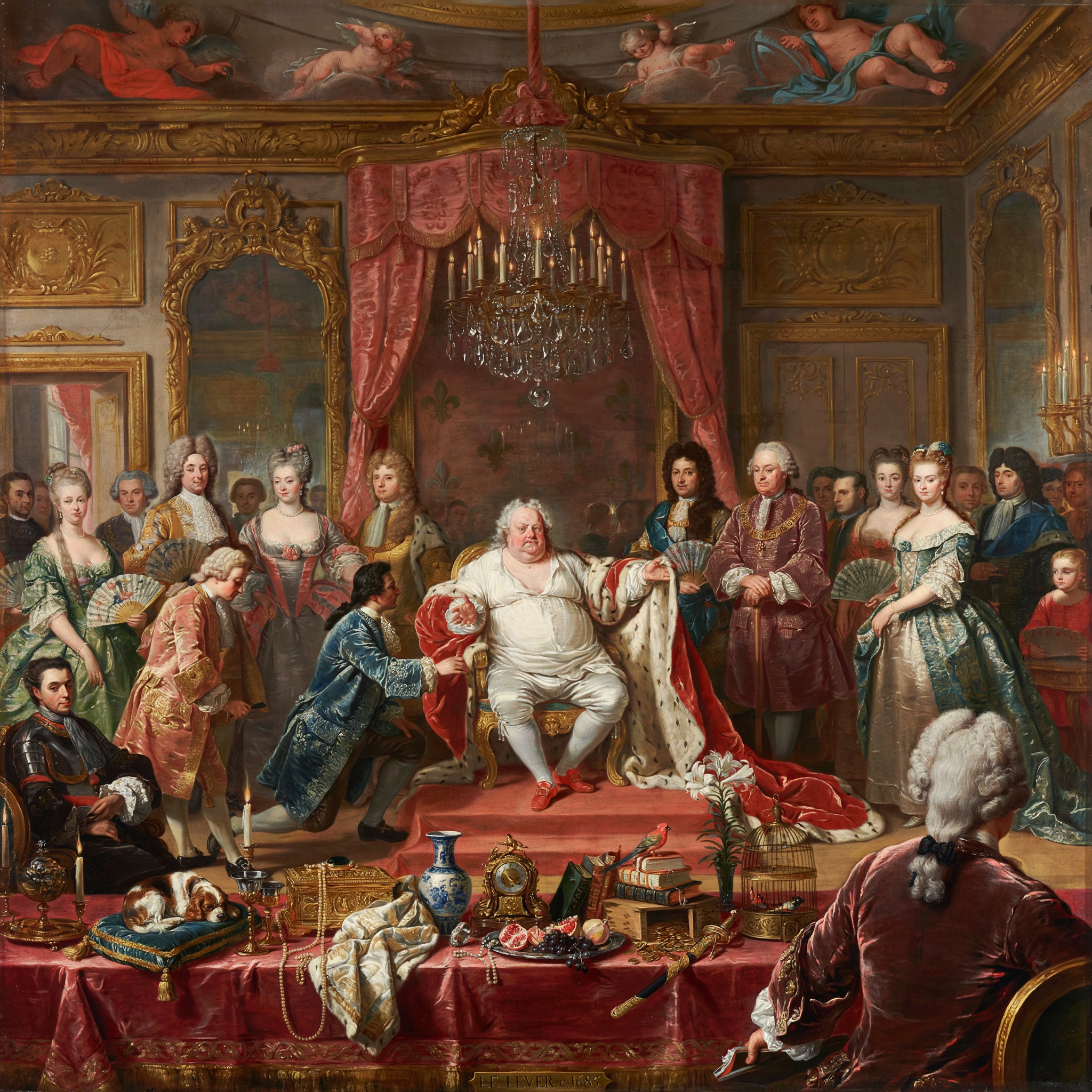 Le Lever, c. 1685 | AI generated image | Ideogram v4
When the king ended the nobility's military autonomy, the competition for status shifted from warfare to behavioral refinement.
Taste literally replaced combat.
Dukes competed for the honor of handing the king his morning shirt. A servile act was converted into supreme distinction through royal proximity, with pensions and political protection sustaining the fiction. Nobles mortgaged estates to maintain appearances at court. Aesthetic participation was economically coercive, dressed up as voluntary refinement.
The trick still runs. Listen to the way a certain kind of founder or operator talks about taste today.
We just have it. You either get it or you don't. The reference library is treated as innate. The parents who took you to the museum, the school that kept Domus in the library, the older friends who already worked in design, the years of having the time and quiet to consume. All of that gets folded back into personality. The labor disappears, and what remains looks like a property of the person.
Sprezzatura is the load-bearing move of every taste regime since the Renaissance. The labor has to be invisible, or the taste doesn't read.
Taste has a job
Pierre Bourdieu's Distinction(1979) is the book that takes the trick apart. His argument, compressed: Taste is the primary mechanism by which class reproduces itself disguised as preference. Not just what you can afford. That's vulgar, that's not yet taste. Taste is the configuration of references, refusals, and small choices that signal which world you belong to. The configuration is learned the way a first language is learned. At home, early, without anyone calling it instruction.
He proved it with data. French survey responses from 1963–68, taste preferences across food, music, home decoration, art, clustering by class position with near-perfect regularity. The correlation is reproduction, not coincidence.
Taste classifies, and it classifies the classifier.
That's why taste reads as natural to the person who has it. They didn't sit down and study. They absorbed. The absorbing was the privilege.
The political consequence is that every taste judgment is also a claim about which references count. When someone says a website has taste, they are saying, without having to say it, the references this designer drew from are the references I recognize as real. The judgment is not about the artifact alone. It is about the agreement between the maker's reference library and the viewer's.
In Taste is not a Vibe I assumed the interrogator stands outside this. Consume widely, dissect, develop a position. The wide was doing a lot of work in that sentence. The references you have access to, the people around you who can validate your why, the time and quiet to interrogate at all. None of that is evenly distributed. None of it ever has been.
The argument here is against pretending the conditions are equal, not against building taste deliberately.
Every democratization installs a new gate
The cleanest evidence that taste does political work is that it gets contested every time a new class shows up wanting access to it.
In the eighteenth century, the bourgeoisie has money but no claim to aristocratic taste. So Hume writes Of the Standard of Taste(1757) and Kant writes the Critique of Judgment(1790), and each tries to anchor taste in something universal: a faculty all reasoning beings share. Read sociologically, this is a class transition smuggled in as philosophy. We can be tasteful too, because reason is universal. The argument supplies the warrant for a new entrant.
The nineteenth century institutionalizes the arbitration. The professional critic emerges (Ruskin, Baudelaire, Sainte-Beuve). Museums, salons, conservatories. Aristocrats no longer own taste outright, but a new clerisy with bylines does. The gate moves; it doesn't disappear.
Early modernism does something stranger: it fuses taste with morality. Adolf Loos's Ornament and Crime(1908) argues, with a straight face, that decoration is a sign of primitiveness, and a tattooed body a degenerate one. "The Papuan who tattoos everything" is at the bottom of his hierarchy; the minimal modern European at the top. The Bauhaus turns this into a program of human improvement. Form follows function is a political position dressed as an aesthetic one, not a neutral principle.
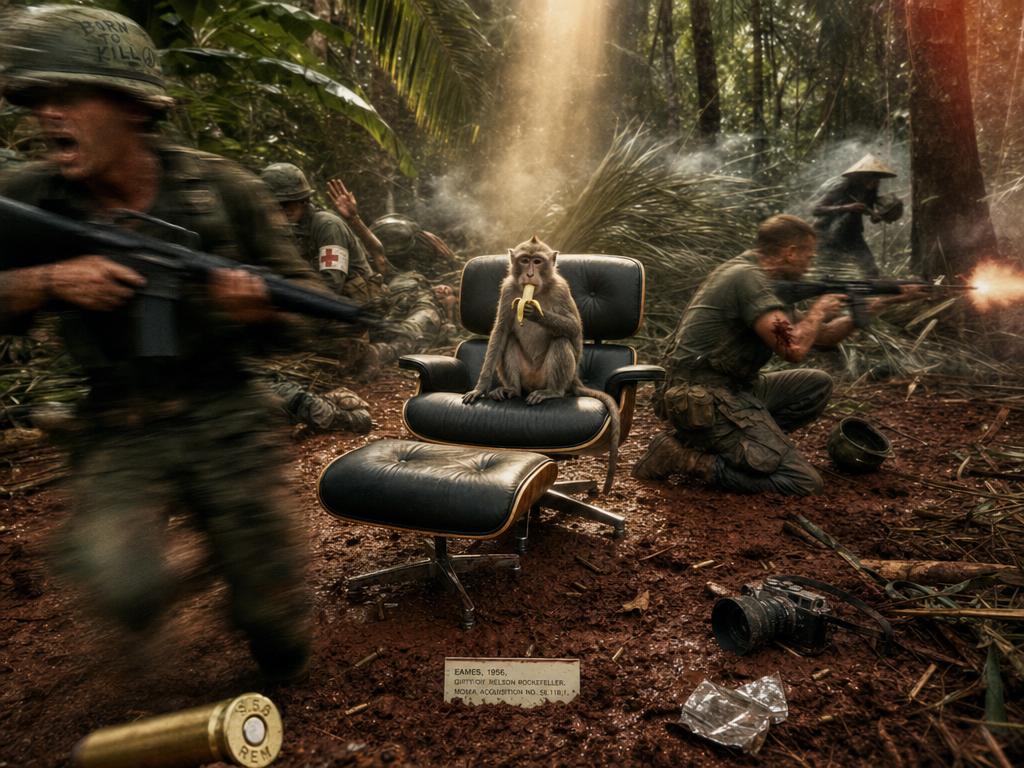 The Eames in the Clearing | AI generated image | GPT Image 2
Then come the museums as policy instruments. Alfred Barr's 1936 Cubism and Abstract Art diagram at MoMA, one hand-drawn chart by one curator, becomes the organizing framework for modern art history textbooks and MoMA's permanent collection at the same time. By 1960 the New York Times is calling Barr "the most powerful tastemaker in American art." Eva Cockcroft's Abstract Expressionism, Weapon of the Cold War(ArtForum, 1974) showed that MoMA's international exhibitions of the period were designed as Cold War propaganda. Nelson Rockefeller "consciously used Abstract Expressionism, the symbol of political freedom, for political ends." Museum taste was U.S. foreign policy.
The Bauhaus story is the same shape. Gropius to Harvard, Albers to Black Mountain and then Yale, Mies to IIT. One school's aesthetic became global modernist orthodoxy through elite university placement, not through proven superiority over its alternatives. Gropius's own words: America was "becoming a reservoir for scattered Bauhaus energies." The reservoir is now every SaaS landing page.
By the time you reach the late twentieth century, the pattern is set.
Each time taste opens up to a new class, a new medium, a new audience, a new gatekeeping mechanism installs itself at a higher level of abstraction. The aristocrats lose taste; the critics get it. The critics lose taste; the brands get it. The brands lose taste; the platforms get it.
The democratization is real. The gate is also real. Both can be true.
Brands are taste, outsourced
For most of the twentieth century, the dominant taste technology is the brand. A brand is a condensed taste position. A name you can attach to your purchases and have them read coherently.
Chanel meant sophistication.
Levi's meant authenticity.
Marlboro, after one of the great brand repositionings in advertising history, meant a particular American masculinity.
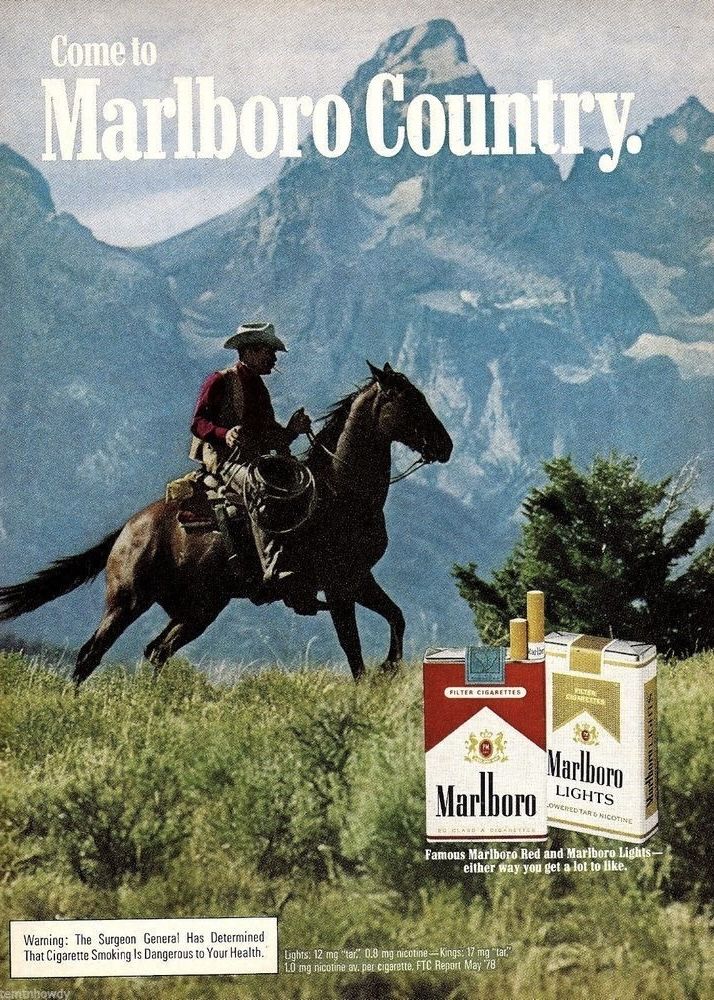 Marlboro Ad | Pinterest
The brand solved a real problem. Mass production made objects affordable; mass media made an anonymous audience. You couldn't read a stranger's taste from their belongings the way a courtier could read another courtier. So the logo became the legible part.
You delegated your taste to the company, and other people read the company's position instead of yours.
Lifestyle brands later perfect this move. Apple. Patagonia. Whole Foods. Soho House. A24. You aren't buying a laptop or a jacket or a film. You are buying a position in taste-space.
The product is incidental; the membership is the value.
And from there it is a short walk to taste as a hiring filter.
"Culture fit" is the polite version. "Has taste" is the direct one. Both phrases do the same work. They convert an unfalsifiable judgment into an employment criterion. You cannot appeal it. You cannot, in any clean sense, show your work, because the criterion is precisely that the work shouldn't show.
Lauren Rivera's study of elite firm hiring (American Sociological Review, 2012) found that evaluators "primarily hired candidates based on personal feelings of comfort, validation, and excitement over identifying those with superior cognitive or technical skills." Candidates with similar credentials received offers two to four times higher based on cultural match. The leisure markers that counted (crew, lacrosse, skiing) have design-industry equivalents. Which typefaces you cite. Whether you're active on Are.na. The school name on the bottom of your CV. The VC pattern is in the same shape. Beta Boom found that 69% of investments at ten leading firms go to top-twenty-school alumni, even though alumni outside the global top hundred are equally likely to build unicorns. The pedigree filter does not predict success. It predicts pedigree.
If you read this back through Castiglione, it is the same trick. The labor of acquiring the right references gets erased, and what remains looks like a property of the person. We have built the hiring funnel of a generation of companies on sprezzatura.
This is what I mean when I say taste is a political technology. It is doing political work, distributing access to capital, jobs, and prestige, while presenting itself as nothing more than a feeling about fonts.
The cycle eats its own opposition
The other half of the story is that taste regimes keep getting overthrown from below.
Mass taste produces its own opposition: punk, hip-hop, ballroom culture, hardcore, riot grrrl, Memphis, gorpcore, whatever is next.
Dick Hebdige's Subculture: The Meaning of Style(1979) is the canonical reading.
A subculture, in his sense, is a community sealed off enough (by geography, identity, or risk) to develop an aesthetic in opposition to the mainstream, using illegibility as protection.
The safety pin, the dropped shoulder, the chopped Honda, the slang term. These aren't bad taste. They are another taste, deliberately closed to outsiders.
What makes a new aesthetic revolutionary, and not just new, is that the aesthetic move is the political claim. Not an illustration of one.
Punk in 1976 was three years of explicit refusal of rock's professionalization and class aspirations. Workers at the pressing plant refused to print the God Save the Queen sleeve. The BBC banned the song. Retailers refused to stock it. Every institution that handled the object understood it as political before it was aesthetic. Three years later, Crass wrote: "What had started as an anti-capitalist revolution had become a meaningless fashion."
The Memphis Group in 1981 made furniture that was functional but refused to function. Shelves at odd angles. Plastic laminate, the cheap kitchen material, used for expensive objects, to short-circuit the class coding of materials.
Sottsass said the intent plainly: expose "good design" as bourgeois ideology. Critics responded by naming the political stakes for him. "A regression toward petit-bourgeois bad taste." "A shotgun wedding between Bauhaus and Fisher-Price." The insults name the class violation that was the point. Sottsass dissolved the group in 1988: "Memphis has accomplished its mission." It had been absorbed.
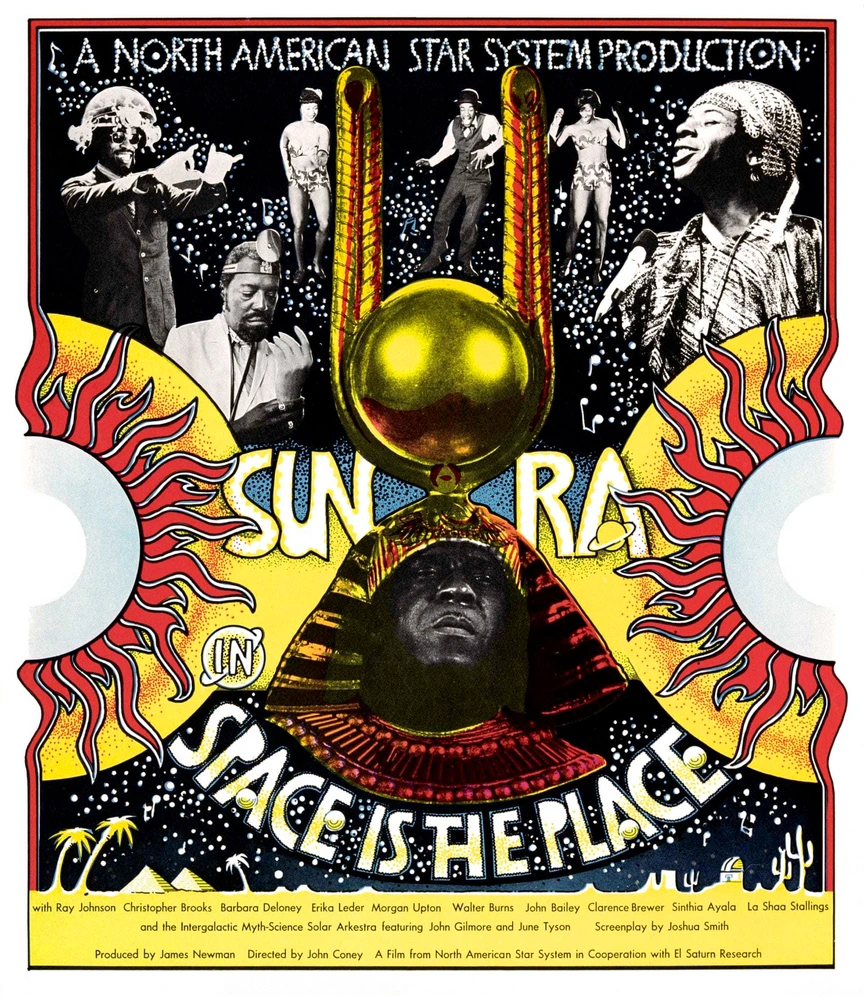 https://nmaahc.si.edu/object/nmaahc_2012.46.59
Afrofuturism is the cleanest case. The political claim was about whose futures got imagined. Sun Ra claimed alien origin to refuse the terms of an American society that denied his humanity. Mark Dery coined the term in 1994 as "African-American signification that appropriates images of technology and a prosthetically enhanced future."
Kodwo Eshun called it "chronopolitical intervention." The absorption point was a Marvel franchise.
In every case the existing order responds with suppression before absorption. It recognizes that what's really being contested is the naturalization of power as preference.
Then the cycle runs. A photographer notices. A designer borrows. A magazine spreads it. Within a few years the markers are extracted from the community that made them, stripped of their politics, and sold back to a wider audience as flavor. Punk becomes mall punk. Hip-hop becomes luxury. Streetwear becomes Supreme × Louis Vuitton.
The pattern is called recuperation, and it isn't a bug. It is the way mass taste metabolizes dissent. The system is structurally hungry for new aesthetic material, because its own median calcifies.
The underground supplies the energy; the mainstream supplies the recuperation; the cycle is what keeps the whole apparatus alive.
The political effect is that opposition gets converted into product. The community that did the work of incubation rarely captures the value of it. Paul Whiteman earned a million dollars in a single year as the "King of Jazz" while Black innovators were excluded from the rooms where their music was now played. Dapper Dan built the visual grammar of hip-hop luxury in a 125th Street basement for thirty years before Gucci copied his 1989 jacket in 2017, called it a "homage," and, only after social-media backlash, offered him a collaboration.
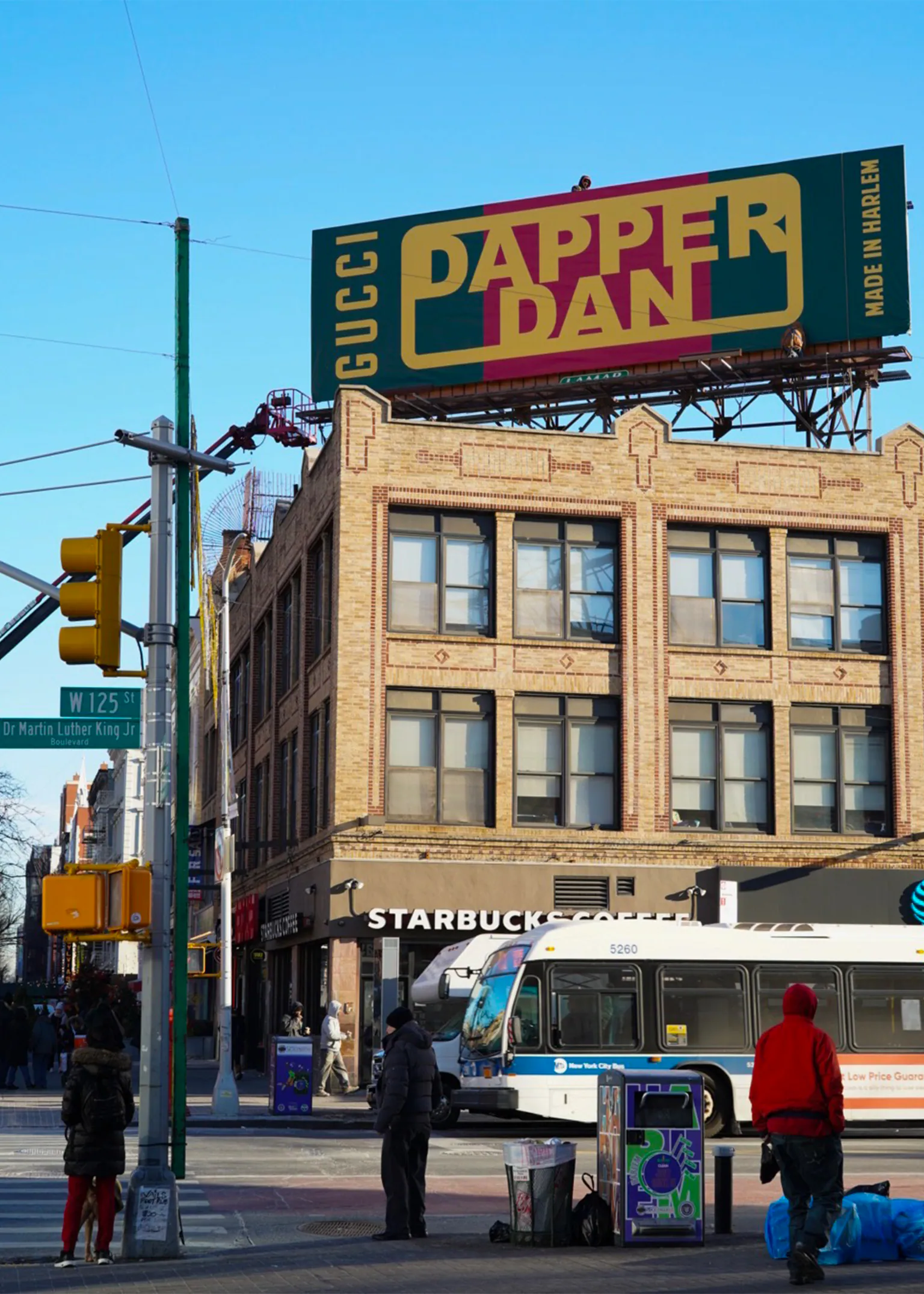 https://www.gucci.com/us/en/st/stories/article/dapper-dan-atelier
The Bridgeport Music ruling in 2005 told the South Bronx that its central creative technique required permission from those who owned the archive: get a license or do not sample. The Dust Brothers estimate that the 105 samples on Paul's Boutique (1989, licensed for $250,000) would cost twenty million today.
The aesthetic moved democratically. The money did not.
The cycle now runs in months
What's different in the last decade is the speed.
Punk had roughly five years between the first 100 Club shows and the safety pin on a Macy's display. Cottagecore, normcore, indie sleaze, dimes square, mob wife: each of these moved through the full Hebdige arc in months. Cottagecore went from Tumblr to ASOS in about three months. Mob wife went from one Canadian TikTok in January 2024 to fast-fashion racks in about three weeks.
Some of these never had a community behind them at all. They were costumes from the start, ready-recuperated, with no incubation phase to skip.
This is what people mean when they call something a "core" instead of a subculture.
A subculture has a neighborhood, a politics, a way of recognizing each other across a room. A core has a search term and a Pinterest board.
The cycle has been compressed so far that the first step (the sealed community) barely happens anymore. Which means the raw material for taste-renewal is drying up at exactly the moment the system that depends on it is running at the highest tempo it has ever run.
And the costumes don't stay neutral. Cottagecore began on Tumblr as a queer aesthetic, the pastoral as refuge. When TikTok extracted the visual grammar (linen, sourdough, the gingham apron), it stripped the queer politics. Into the emptied vessel moved tradwife influencers and ecofascist accounts. A 2025 study of post-2022 tag environments tracked the drift from #flowercore to "traditional gender roles."
De-politicized aesthetics do not stay neutral. They get re-politicized by whoever moves next.
The recommendation system makes this worse, not better.
The platform doesn't widen your reference library. It deepens the trough you are already in. My own prescription of wide consumption is structurally hostile to the system delivering most of the consumption.
The algorithm is in the business of narrowing you, because narrowed people are easier to predict and serve.
And then the generative-AI loop, which is the politically consequential version of AI commoditizes production. Models trained on aggregated taste produce median-aesthetic outputs. The outputs flood the feeds. The feeds become tomorrow's training data.
A 2025 PMC study tracked seven hundred generation trajectories and found them converging on just twelve visual attractors. Model collapse loses the tails first. Subcultural aesthetics are the tails.
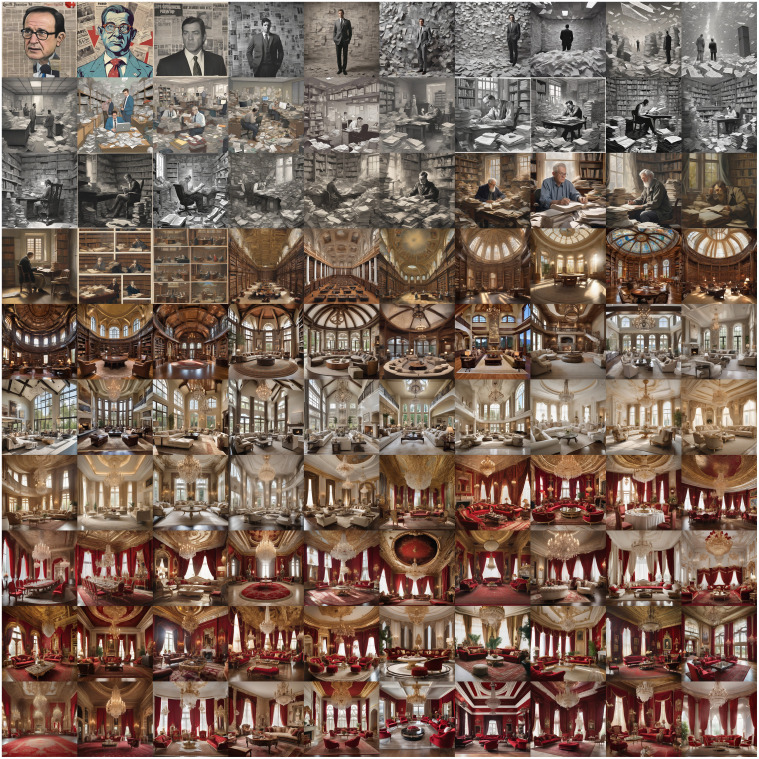 https://pmc.ncbi.nlm.nih.gov/articles/PMC12827715/
The training pipeline itself is the most aggressive extraction event in the history of aesthetic commerce.
Every prior recuperation operated at human speed. The AI training pipeline executed the same logic once, permanently, at machine speed, against the entire corpus of human visual aesthetic production online.
David Holz, Midjourney's founder, was asked in 2022 whether he sought consent from living artists or work still under copyright. "No. There isn't really a way to get a hundred million images and know where they're coming from." There was no opt-out. There still mostly isn't.
Greg Rutkowski is a Polish digital artist whose work appears in Horizon Forbidden West and Magic: The Gathering. In one month in 2022, his name appeared in roughly ninety-three thousand Stable Diffusion prompts. Picasso's appeared in two thousand. A living, working artist had his style reproduced at forty-six times the rate of Picasso. Users signed outputs as him. When Stability AI removed his name from later models, the community independently trained a small model to keep reproducing his style and released it publicly.
In 2024 a leaked Midjourney spreadsheet listed sixteen thousand artists (Frida Kahlo, Yayoi Kusama, Banksy, David Hockney) allegedly preloaded into the training system. Not passive scraping. Deliberate aesthetic cataloguing.
 The 16,000 Names Memorial | AI generated image | Ideogram v4
Matthew Butterick, lead attorney on the Andersen v. Stability AI* *class action, called the products "copyright-laundering devices, promising customers the benefits of art without the costs of artists."
Call this recuperation at industrial scale. The taste that is now the scarce, valuable layer was built by artists. The scarcity was manufactured by the companies who trained on that taste without paying for it. The profit flows to the companies. The creators get declining commissions and a lawsuit they may not win.
When the taste discourse says AI commoditizes production, this is what is meant. Not that the production got cheap.
The substrate of taste got privatized.
The privilege is opting out
If taste is the scarce skill, and the algorithmic median is the new default, then the politically interesting position is the one that opts out.
The founder who reads books instead of feeds. The designer who buys old magazines. The writer who turns off recommendations. Wide consumption, deliberate interrogation, references the algorithm didn't choose for you. The privilege to consume against the grain.
But notice what opting out requires.
Time. Attention without commercial pressure. A social environment where not being current on the latest core is socially survivable. Often, money. Sometimes, a community that has been building its own reference library for a generation.
In other words: the conditions to build taste in the deliberate-practice sense are distributed almost exactly as they were at Versailles.
The court has new architecture. It still has a guest list.
This is the politics the current taste discourse skips over. We have agreed that taste is the scarce skill in an AI-saturated economy. We have not yet agreed that the inputs to that skill, the time, the references, the company, the permission, are unevenly distributed in ways that map almost exactly onto the older hierarchies the AI moment was supposed to flatten.
The risk is that taste becomes the soft credential of the next decade. Harder to verify than shipping code. Easier to weaponize than a degree. Naturalized in a way that hiring committees will struggle to question, because the whole point of the move, since 1528, is that the work doesn't show.
Taste is a position
I have been describing one face of the mechanism so far. The gate. The credential. The room you can't get into. There is a second face I haven't named yet, and it is the one most people actually live inside.
The same machine that closes the door from above opens a window from below. The hierarchy that says you don't have taste to the outsider also sells the outsider a way to look like they belong.
The Apple keynote. The A24 jacket. The Glossier kit. The algorithmic feed of "tasteful" content the platform decided you would like. The seduction is simply the consumer side of the credentialing machine.
The exclusion creates the demand.
The marketplace supplies the substitute. The hierarchy stays intact because the substitute can always be told apart from the real thing, by the people inside the room. That detectability is the engine of the whole cycle.
This means the political danger of taste shifts with where you stand. If you are already inside, you risk performing sprezzatura: gatekeeping by feel, deploying the credential against people who can't see the mechanism.
If you are outside, you risk buying the position instead of holding one: accepting the manufactured substitute for the thing it is meant to substitute for. Most people are doing both, in different rooms, on different days.
Taste is an aesthetic position. Not a preference, not a credential. A position.
Individuals hold them. Studios hold them. Magazines, labels, museums, agencies hold them. A position is built (wide consumption, deliberate interrogation, references you can defend, refusals you can defend) and it is the only thing that works against both faces of the machine. A position you actually hold cannot be gatekept against. You have somewhere to stand. It cannot be sold to you either. You already have your own. Holding a position is not the absence of vulnerability to the system. It is the form of vulnerability that doesn't capitulate.
The catch, the part the discourse keeps not saying, is that almost nobody has one. Not really.
What most people have is an inherited reference library, lightly edited by an algorithm, dressed up in the brand logo of a company that sold them the substitute.
The death of taste is the moment a consumer gives in to a corporate desire and calls the giving-in preference.
It happens daily. It is not dramatic. It looks like watching what was recommended, reading what was promoted, buying what the feed served, and forgetting that you didn't choose any of it.
And yet the cycle has never stopped producing new aesthetics. It does this in the only place it can: the small, mundane refusals that look like nothing from the outside.
What you watch when no one is looking. What you read off the recommendation. What you put on your walls. What you cook when you are cooking for yourself.
Every aesthetic revolution in the last hundred years (punk, hip-hop, Memphis, ballroom, gorpcore, the anti-AI marking) started this way.
Everyday choices that did not trend.
 Vanitas, 2026 | AI generated image | Ideogram v4
People who were not waiting for permission. The mainstream absorbs them eventually. New ones emerge. The cycle is not optional. The system needs the dissent to keep running.
The question is whose dissent it is? & What is your taste?
Not the brands you have affiliated with. Not the references you have been credentialed by. Not the feed you have been served. The position you actually hold, when you take all of that away. The thing you would be drawn to in a room with no logos and no algorithm. The aesthetic you would build out of nothing, if nothing was given.
Further Reading
Castiglione, The Book of the Courtier (1528): Public Domain Review collection
Elias, The Civilizing Process / The Court Society: University of Chicago Press, Oregon course summary
Bourdieu, Distinction: A Social Critique of the Judgement of Taste (1979): full text PDF
Hume, Of the Standard of Taste (1757): davidhume.org
Kant, Critique of Judgment (1790): Stanford Encyclopedia of Philosophy entry
Loos, Ornament and Crime (1908): full text PDF, colonial reading by Korody
Alfred Barr, Cubism and Abstract Art (MoMA, 1936): exhibition page
Eva Cockcroft, "Abstract Expressionism, Weapon of the Cold War" (Artforum, Summer 1974): Artforum archive
Bauhaus diaspora to American universities: ArchDaily survey
Marlboro Man and brand repositioning: Quartr case study
Lauren Rivera, "Hiring as Cultural Matching" (American Sociological Review, 2012): Northwestern Scholars listing
Beta Boom, "Pedigree bias in venture capital": full report
Hebdige, Subculture: The Meaning of Style (1979): overview
Marcus, Lipstick Traces: A Secret History of the 20th Century (1989): overview
Jamie Reid and the Sex Pistols visual language: The Conversation obituary
Crass, "Punk Is Dead" and the DIY refusal: Far Out essay
Memphis Group and Sottsass: Hart Design Selection, We Are The Mutants
Mark Dery, "Black to the Future" (1994): full text
Kodwo Eshun, More Brilliant Than the Sun: Adventures in Sonic Fiction (1998): overview
Amiri Baraka, Blues People: Negro Music in White America (1963): Blues Foundation entry
Bridgeport Music, Inc. v. Dimension Films (6th Cir. 2005): case summary, full opinion
Dapper Dan and the 2017 Gucci jacket: Okayplayer report
Rebecca Jennings on TikTok microtrends: Vox piece, via Yahoo
K-HOLE, "Youth Mode: A Report on Freedom" (2013): Rhizome anthology, background on Normcore
Cottagecore → tradwife drift: GNET on reactionary co-option, Polyester on retrofuturism and fascism, arXiv 2505.04561: empirical Tumblr tag study
"Autonomous Language-Image Generation Loops Converge to Generic Visual Motifs" (PMC, 2025): 12 attractors study
Shumailov et al., "AI Models Collapse When Trained on Recursively Generated Data" (Nature, 2024): paper
David Holz on Midjourney's training data: PetaPixel interview write-up, 2022
Greg Rutkowski and the volume of Stable Diffusion prompts: MIT Technology Review profile
Leaked Midjourney style list (16,000 artists, 2024): The Art Newspaper
Andersen v. Stability AI class action: Copyright Alliance case page
Kyle Chayka on the algorithmic feed: Filterworld (2024)
Analog privilege and opting out: TechPolicy.Press, "The Future Is Analog (If You Can Afford It)"
Read more
- Refining the design process with AI in 2026I moved the design process at Dashverse from Figma to Claude Code and GitHub. Design output doubled. Here's what that actually looks like.
- Dashtoon studio 2023-24 | Webcomic creation platform Designing a webcomic creation platform from scratch pushing content creation velocity to 5x.
- Frameo.AI 2025 | HighlightsHighlights from 2025, on the journey building Frameo.AI, a chat-first AI native storytelling tool.